Same 800G. Fewer watts. Every hour of every year.

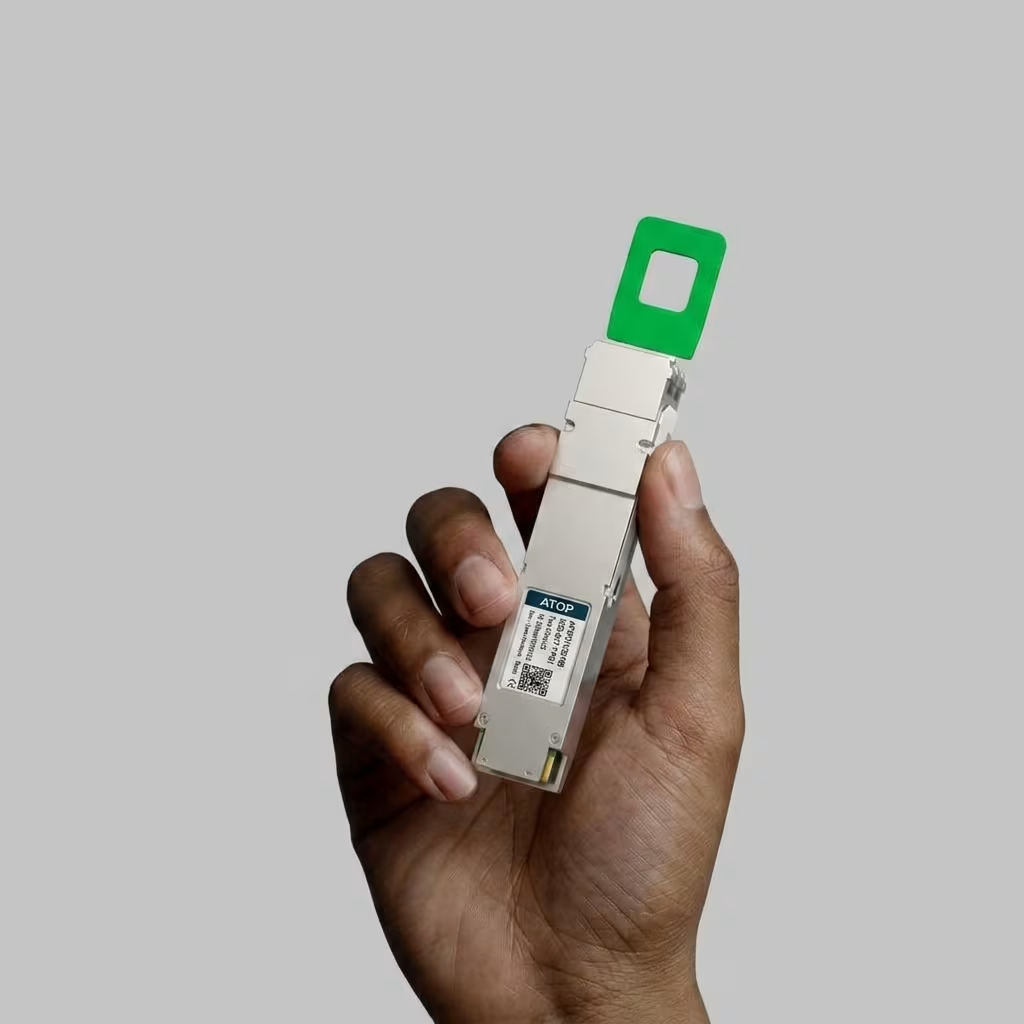
The 800G OSFP 2xFR4, built to run below 11W typical against a 15W market standard.

For the operators, resellers and enterprises deploying optics at scale, that gap is a line on the power bill you haven't looked at yet.

Three stat markers under it: below 11W typical / 13W maximum at full temp / 15W+ market standard.

The one line item you can still optimise

An AI cluster's bill of materials is mostly fixed. The switches, the GPUs, the fabric, all specced and locked. Optics is different. It's the one component where a better choice quietly changes your operating cost for the life of the deployment.

Power is where that choice shows up. Most 800G 2xFR4 modules are specified at 15W and above. Ours run below 11W typical, with a 13W maximum published on the datasheet. Four watts a port doesn't sound like much. Across a cluster, running continuously, it compounds into real money and real carbon.

What four watts is worth at scale

A single module saving four watts is easy to dismiss. A deployment of several thousand ports running around the clock is not.

At ten thousand modules, the difference is roughly half a gigawatt-hour a year, tens of thousands of dollars, and over a hundred tonnes of CO2. Every year the cluster runs. The number that matters isn't the annual figure, it's the five-year one, because that's the life you're buying.

Set your own deployment below and see what the gap is worth to you.
Total 800G 2xFR4 ports in the deployment
Your cost per kWh
$ / kWh
Power usage effectiveness, includes cooling. 1.0 counts the module only
Your grid's emissions per kWh
kg / kWh
Annual cost saved $59,000 across 10,000 modules, every year
Annual energy saved 490 MWh module draw plus cooling
Annual CO2 avoided 172 t at your grid factor
Over five years $295,000 saved 2,450 MWh energy 858 t CO2

Illustrative, based on published market specifications. Saving assumes 4W per module (below 11W typical against a 15W market spec) running continuously at 8,760 hours a year, scaled by the PUE you set. Actual figures depend on your electricity price, PUE and grid carbon factor.
Available at the volumes you actually deploy

A better module is only better if you can get it in the quantity you need, when you need it. We build the 800G 2xFR4 at the volumes Tier 1 operators require, and we hold stock rather than making you wait behind an allocation queue.

That means a NeoCloud scaling a build, a VAR fulfilling against a contract, or an enterprise standing up a cluster all get the same answer: yes, at that quantity, on a timeline that works.

Why the number holds at volume

The 11W figure isn't inherited from a reference design. We design and build these modules ourselves, so the thermal and power work is ours.

That has one practical consequence worth caring about. What you qualify from a sample is what arrives in the shipment. The power performance doesn't drift between the unit you test and the ten thousand you deploy, because the same lines build both. Consistency at scale is the part that's hard to buy from a distributor, and it's the part we control.

You don't have to change supplier

If you already have a preferred optics source, keep it. Optics is genuinely dual-sourceable. Same form factor, same MSA, same interface, so qualifying a second source doesn't disrupt anything you're already running.

Qualify us alongside what you buy now. Then choose, port by port, where the watts and the lead time work in your favour. Nothing gets ripped out, and you bank the difference on the ports where it counts.

You've seen what you can save. Get both datasheets.

Full specs for the Close Top and Open Top variants, sent straight to your inbox.
arrow-right