
We'll be at ANGA COM 2026. Let's talk.
Cologne, 19-21 May - we're not exhibiting, we're visiting, and Søren and Helene have three days set aside for the conversations that matter.
meet Søren and Helene

Two things are changing, fast.
The first is regulation. NIS2 is live. CRA is coming. CSRD is reshaping how operators report on what they buy. The pressure to actually prove what's inside the transceivers in your network - where the components came from, who made the firmware, what the carbon footprint looks like - is no longer a future problem.
The second is the supply chain itself. More operators are realising that the gap between buying through a reseller and buying from the actual manufacturer is bigger than it looks. Traceability, vendor coding flexibility, country of origin honesty, batch consistency - these don't really exist when the label gets swapped between factories.
Both of these are conversations worth having in person. Which is why we're going.
The second is the supply chain itself. More operators are realising that the gap between buying through a reseller and buying from the actual manufacturer is bigger than it looks. Traceability, vendor coding flexibility, country of origin honesty, batch consistency - these don't really exist when the label gets swapped between factories.
Both of these are conversations worth having in person. Which is why we're going.
We make the transceivers.
You can buy them from us directly.
This still surprises people, which says a lot about how the industry has worked for the last twenty years. Most optical kit reaches operators through layers of distributors and private-label resellers who don't actually make anything.
ATOP is different. We design, manufacture and test every module in our own facilities - Mianyang and Jiangyou in China, Penang in Malaysia, with R&D in Chengdu and fulfilment hubs in Denmark, the US and Singapore. There's no middle layer. When you talk to us, you're talking to the people who built what you're buying.
If you've never bought direct from a manufacturer before and you want to understand what that actually looks like in practice, that's exactly the kind of conversation Søren and Helene want to have in Cologne.
ATOP is different. We design, manufacture and test every module in our own facilities - Mianyang and Jiangyou in China, Penang in Malaysia, with R&D in Chengdu and fulfilment hubs in Denmark, the US and Singapore. There's no middle layer. When you talk to us, you're talking to the people who built what you're buying.
If you've never bought direct from a manufacturer before and you want to understand what that actually looks like in practice, that's exactly the kind of conversation Søren and Helene want to have in Cologne.

Proof over promises.
The optical industry has a lot of claims and not much evidence. We'd rather show you the documentation.
100% traceable BOMs

Every component, every assembly, every module - linked to an audited supplier.
NIS2 and CRA ready

Secure-by-design firmware that we own and can patch. Country of origin declarations that hold up under scrutiny.
68+ patents

Real R&D from a real engineering team in Chengdu.
What's worth a conversation in Cologne?
A few of the things Søren and Helene will be ready to dig into:
Buying direct from the factory and what changes when you do.
Compliance posture for NIS2, CRA and CSRD - what it actually means for transceiver procurement, not the headline version.
Vendor-specific coding and how we handle it.
Lead times, batch consistency, and what "manufacturer-direct" looks like through a full procurement cycle.
TAA-compliant and country-of-origin specific options.
LPO and the efficiency case for hyperscale and high-density deployments.
The economics of taking back and recovering modules at end of life.
If there's something else on your mind that's not on this list, even better. The most useful conversations usually start somewhere unexpected.

One more thing - if you're a partner, ask us about the portal
We've been quietly building a partner portal that brings together training, sustainability reporting, custom presentations, and a live datasheet library. Version one launches around ANGA COM.
If you partner with ATOP today, or you're thinking about it, ask Søren or Helene to walk you through it in Cologne.
If you partner with ATOP today, or you're thinking about it, ask Søren or Helene to walk you through it in Cologne.
The two people you'll meet.
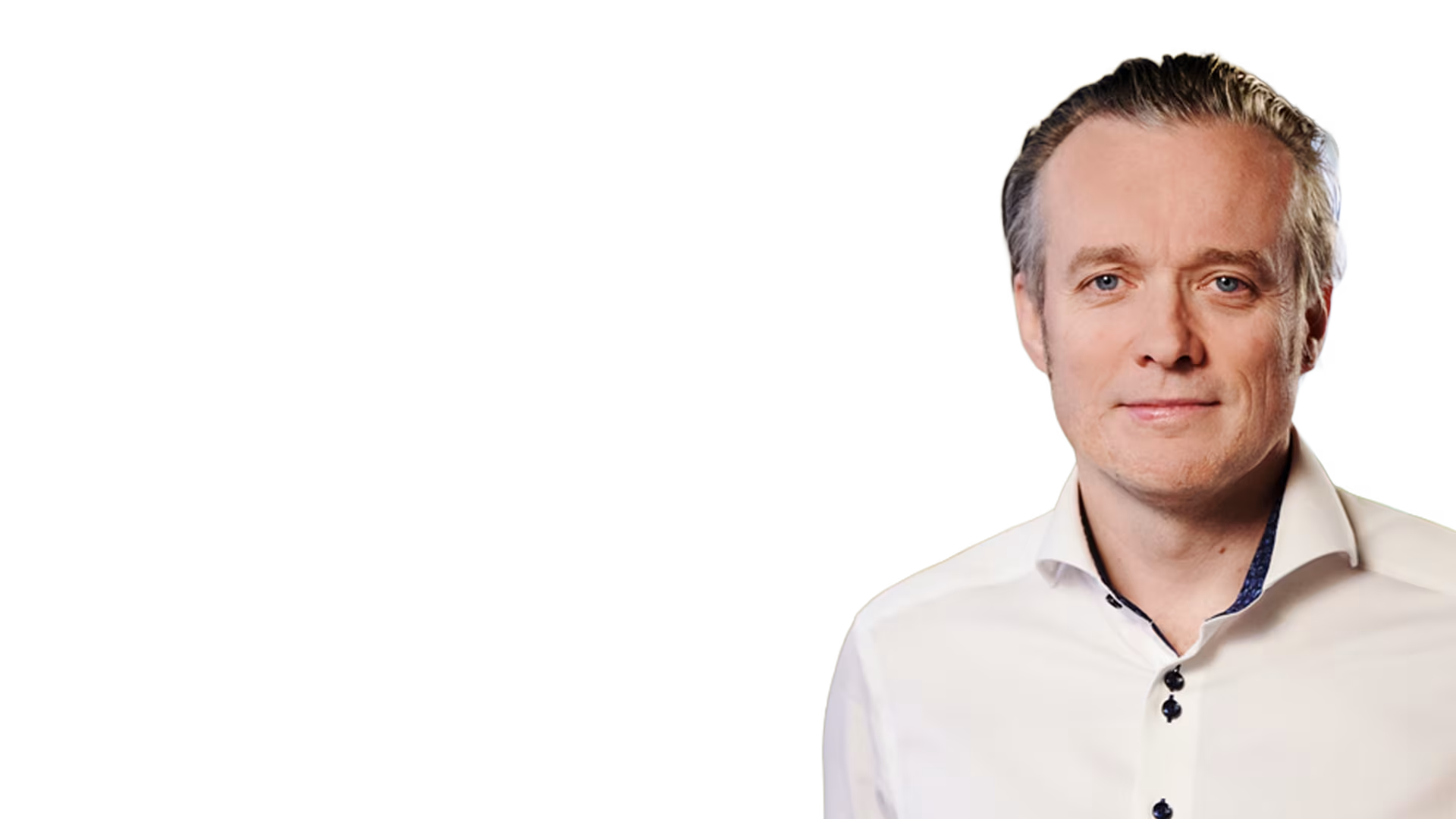
Søren Sørensen
Chief Growth Officer
Driving global growth across AI and hyperscale infrastructure, Søren works directly with customers to design and future-proof high-performance optical and copper interconnect solutions, from dense 800G GPU clusters today to the 1.6T architectures coming next.

Helene Orr
European Business Lead
With 20+ years in the industry, Helene combines deep European market insight with a passion for partnership, guiding customers from legacy upgrades to AI-ready 800G and 1.6T deployments, built on reliability, resilience and long-term collaboration.
Want to meet?
Drop Søren or Helene a LinkedIn DM. Tell them what you'd like to talk about, and they'll find a slot.
We're in Cologne all three days, 19, 20 and 21 May. The earlier you reach out, the better the chance of getting a time that works for both of us.
We're in Cologne all three days, 19, 20 and 21 May. The earlier you reach out, the better the chance of getting a time that works for both of us.